day of the dead · mom · ofrenda
The bread tastes like nothing now
On November 3rd the ofrenda comes down. An afternoon at my mom's packing up candles, a pan de muerto someone else already tasted and Grandpa's crooked photo.
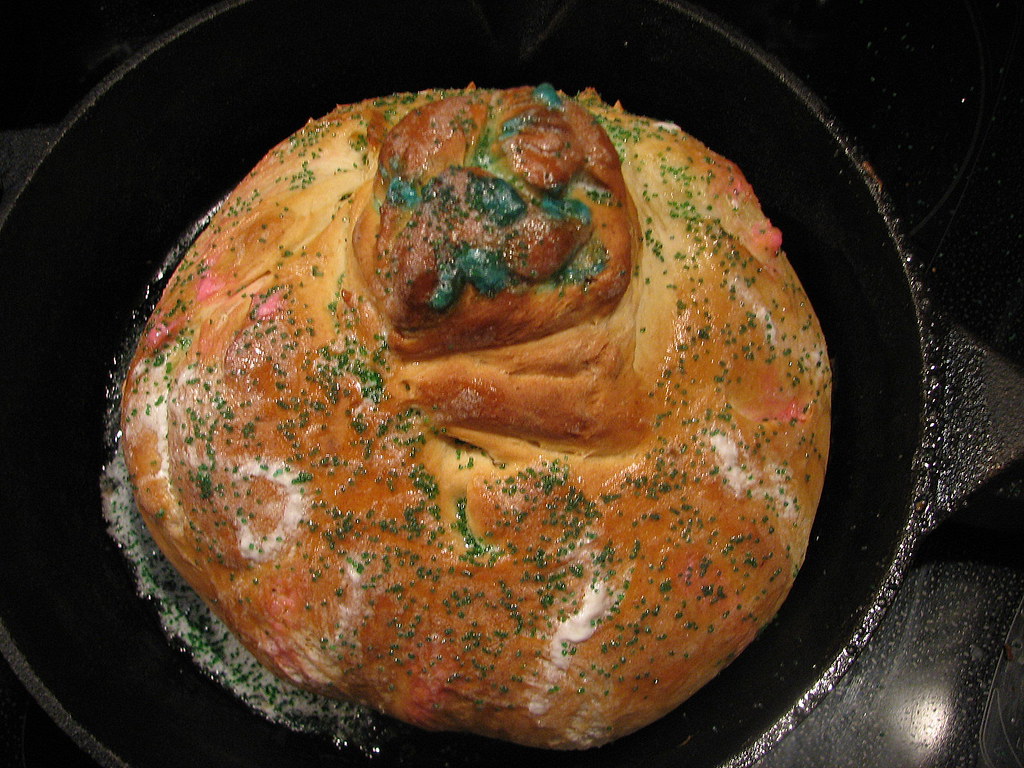
At my mom's house the ofrenda comes down on November 3rd, not before. Not on the night of the 2nd, when everyone's back from the cemetery and you're itching to tidy up, and not on the 4th, because then "it looks like you forgot." The 3rd, in the afternoon, slowly, the same way it went up. She announced it yesterday in the group chat at eleven in the morning, when I'd been asleep for two hours: "Tomorrow at five we take Grandpa down. Bring bags." She said "take Grandpa down" like she was getting him ready for a walk.
Andrea answered that she'd be there at six because she had a parent-teacher meeting. Lucía sent a heart and a photo of her own ofrenda in her apartment, tiny, on top of the microwave: one candle, a photo of Grandpa printed on copy paper and a banana. I wrote "ok" and went back to sleep.
What's left after two weeks
I got there at ten past five with two folded grocery bags in the pocket of my sweatpants. My mom was already sitting on the couch facing the little table, not touching anything, waiting for me. She says she doesn't like to start alone because it makes her sad, but I think she really doesn't like to start alone because then nobody helps her carry the shoeboxes to the back room.
Up close, the ofrenda looked tired. The marigolds from the La Cruz market were dry and bent over, the petals toasted at the edges, shedding orange dust if you touched them. The papel picado had one corner unstuck that fluttered every time someone walked by. The tamales my mom had put out fresh on the 1st were hard as river stones, and the rice pudding, the one in the plastic cup, had grown a thick skin with the cinnamon sunk into it, like a pond that froze with leaves inside. The shot glass of mezcal was empty. I didn't ask.
The bread rule
My mom maintains, and her mother maintained, that whatever stays on the ofrenda loses its flavor because the dead have already eaten it. They don't eat the bread; they eat whatever the bread had inside. So when you take it down, you eat a bit of what you set out, to check. It's a test, like the litmus paper in the nursing school lab, only with sugar.
She broke the pan de muerto with her hands over a napkin. It was dry but not hard, the sugar still clinging. She gave me a piece from the edge, with one of the little bones, and kept the round knob on top for herself, which she's always said is the head and belongs to the eldest in the house. We chewed in silence, watching each other, like we were tasting wine.
"It doesn't taste like anything," my mom said, very satisfied.
To me it tasted like stale bread with a hint of orange. I told her it didn't taste like anything. She nodded like someone confirming a diagnosis.
The bread was one thing, but neither of us dared with the rice pudding. We poured it down the sink and my mom let the water run for a long time, longer than necessary, saying "there, there, there" under her breath, I'm not sure whether to the rice or to Grandpa.
The shoeboxes
Taking it apart is faster than putting it together, and uglier. The shoeboxes that had been steps went back to being shoeboxes, one from a pair of boots my mom hasn't worn since 2015 and another that still says "Flexi, size 24" on the side. The white tablecloth had a wax stain from a real candle that somebody, some year, lit on the sly. We stuffed the dry flowers into one of my grocery bags, and the bag ended up smelling of marigold, that bitter smell of soil and pepper, which stayed on my hands all the way to the hospital.
Andrea showed up at twenty past six with my youngest nephew, who ran in, saw the empty table and asked, "Did Grandpa leave already?" My mom told him yes, until next year. He said "oh" and went looking for the remote. Andrea looked at my hair, touched the back of it as if to make sure it was real and said, "You do look younger, but tired," which from her is a hug.
The photo
In the end only Grandpa Tomás's portrait was left, in its frame, one bottom corner a little higher than the other. My mom picked it up with both hands. Andrea and I stood very still, because we both knew what we were waiting for: whether now, with no altar and nobody watching, she'd straighten it.
She didn't. She wrapped it in a checkered kitchen towel, put it in the sideboard drawer between the Christmas tablecloths and a box of silverware nobody ever uses, and kept her hand in there for a long while, finding it the right angle. Then she closed the drawer slowly, with her hip.
At a quarter to seven I left for the hospital with a piece of bread wrapped in a napkin, because my mom said to give it to Pao, that "it'll taste like something to her." At the light on Constituyentes, out of curiosity, I took another bite. It still tasted like stale bread with a hint of orange. I guess that was the part Grandpa didn't want.
Keep reading
Thirty Centimeters of Bun
I'd worn the same bun since nursing school. On Saturday, after my first run back, I sat down at Doña Yoli's salon and walked out a foot lighter.

A calaverita for Doctor Ruelas
Every October the night shift draws names for calaveritas. I got the doctor who benched me, and I had to read him my verses at four in the morning.
The Neighbor with the Drill Has a Name
Six years hating a drill that wakes me up at noon. With my afternoons free, I finally knocked on his door and found a man who makes wooden cup-and-ball toys.